The UK Government has confirmed a series of changes to its upcoming electric Vehicle Excise Duty (eVED) scheme, introducing special arrangements for fleet operators, leasing companies and vehicle rental businesses ahead of the tax’s planned launch in April 2028. While the new mileage-based tax applies to fully electric and plug-in hybrid cars rather than vans, the changes are particularly important for businesses that manage company car fleets.
The measures follow a public consultation on the policy and are intended to reduce the administrative burden on businesses that manage large numbers of electric vehicles. Although the scheme does not currently apply to electric vans or other light commercial vehicles, many fleet operators and leasing companies manage both company cars and commercial vehicles, making the changes relevant across the wider fleet sector.
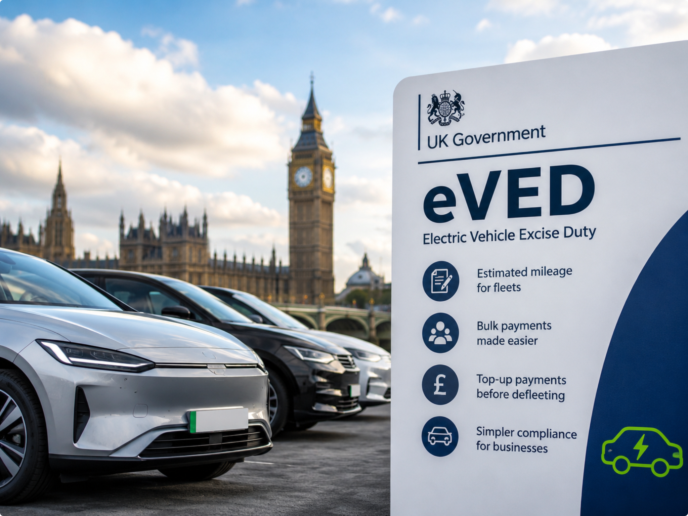
Under the revised approach, eligible fleet operators will be able to submit estimated mileage figures for their vehicles rather than relying on individual drivers to provide odometer readings. The Government believes this will simplify compliance and make the new tax easier to administer across large fleets.

What Is eVED?
Announced during the Autumn Budget, eVED will introduce a mileage-based tax for fully electric and plug-in hybrid cars from April 2028. The policy currently applies to cars and does not extend to electric vans or other light commercial vehicles.
The proposed rates remain unchanged:
- 3 pence per mile for fully electric cars.
- 1.5 pence per mile for plug-in hybrid vehicles.
The Government has confirmed it remains committed to introducing the scheme on schedule despite concerns raised by the fleet industry during consultation.
Estimated Mileage Allowed for Fleets
One of the most significant changes announced is that fleet, leasing and rental businesses will be permitted to submit estimated annual mileage instead of collecting actual readings from every driver.
For most leased vehicles, the estimate is expected to reflect the vehicle’s contracted annual mileage allowance, while rental operators may use average fleet mileage where appropriate.
The Government says this centralised approach removes the need for individual drivers to submit information, making the system significantly more practical for businesses managing large vehicle fleets.
Bulk Payments to Simplify Administration
To further reduce administration, authorised fleet operators will also be able to make bulk eVED payments covering multiple vehicles at fixed intervals.
The Government expects businesses to have access to different payment methods, including:
- API integration for larger fleet management systems.
- A web-based portal for smaller operators.
Detailed guidance and system testing are expected before the scheme goes live.
New Process Before Vehicles Leave a Fleet
Another concern raised during consultation was the possibility of outstanding eVED liabilities remaining on vehicles when they are sold or returned at the end of a lease.
In response, the Government has confirmed that fleet operators will be able to make top-up payments before vehicles are removed from service, ensuring any outstanding tax is settled before disposal and helping avoid complications during resale.
Government Drops Extra Mileage Checks for New Cars
The original proposals suggested that electric cars less than three years old could require additional official mileage inspections, as these vehicles would not yet have undergone an MOT.
Following industry feedback, ministers have abandoned that approach.
Instead, private motorists will provide:
- Their current odometer reading when renewing Vehicle Excise Duty.
- An estimate of the mileage they expect to drive during the following year.
The DVLA will use this information to calculate an estimated eVED liability.
However, the Government says it will still have powers to request an official mileage inspection outside the MOT process where there is reasonable suspicion of fraud or inaccurate reporting.
Connected Car Technology Could Automate Mileage Reporting
The Government also intends to explore the use of connected vehicle technology that would allow motorists to submit mileage data automatically from their vehicles.
If introduced, the system would be voluntary rather than mandatory, giving drivers the option of automated reporting while retaining traditional submission methods.
Industry Welcomes Improvements but Questions the Policy
Industry organisations have welcomed the practical changes made for fleets but continue to question the wider policy.
The British Vehicle Rental and Leasing Association (BVRLA) said the Government had recognised that a system designed around private motorists would not work effectively for commercial fleet operators. However, it maintained that introducing an additional tax on electric vehicles at a time when the UK is encouraging EV adoption risks slowing demand.
Meanwhile, EVA England also welcomed the removal of additional mileage checks for newer vehicles but argued that the overall scheme remains unnecessarily complex. The organisation believes the policy could leave some drivers facing unexpected costs and says further work is needed to improve affordability and public confidence in electric vehicle ownership.
 Call our expert team on