For several years, car-derived vans appeared to be heading toward extinction. Popular models such as the Vauxhall Corsavan, Ford Fiesta Van and Renault Zoe Van gradually disappeared from showrooms, leaving businesses with fewer compact commercial vehicle options. Even niche offerings like the Suzuki Jimny Commercial eventually vanished from the market.
Recently, however, manufacturers have begun revisiting the concept. Rising demand for urban deliveries, growing pressure to reduce emissions and the expansion of low-emission zones have encouraged brands to explore smaller and more efficient commercial vehicles. Toyota‘s Corolla Commercial, the Land Rover Defender Hard Top and electric models such as the Citroën e-C3 Van demonstrate that there is still life in the compact van sector.
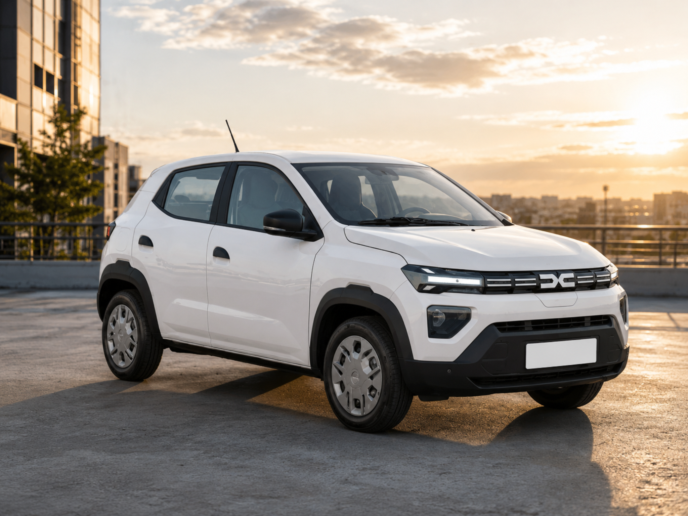
Into this changing market arrives the Dacia Spring Cargo, perhaps the smallest fully electric van currently available. At only 3.7 metres long, it occupies less road space than many city cars and is considerably smaller than traditional light commercial vehicles. In fact, from some angles it resembles a hatchback that has simply had its rear seats removed. While that compact size gives it undeniable charm, it also raises concerns about practicality. Can a van this small genuinely meet the needs of modern businesses?
Exterior Design
The Spring Cargo’s appearance is instantly recognisable. Based on Dacia’s Spring electric city car, it retains the same compact proportions and simple styling. Unlike larger commercial vehicles that often look purpose-built for work, the Spring Cargo maintains a friendly and approachable appearance.
Its compact dimensions are arguably its greatest asset. In crowded urban environments where parking spaces are limited and narrow streets are common, the Spring Cargo feels perfectly suited to the task. Drivers can easily navigate congested city centres and squeeze into spaces that would be impossible for larger vans.
The practical modifications are relatively straightforward. Rear passenger seating has been removed and replaced with a dedicated cargo area, while a bulkhead separates the load compartment from the cabin. This conversion allows Dacia to maximise available space while keeping production costs low.
Performance and Efficiency
Under the bonnet sits a modest 64hp electric motor driving the front wheels. While those figures will not excite performance enthusiasts, outright speed is not the purpose of this vehicle.
Acceleration is smooth and predictable, making it ideal for stop-start urban traffic. Pulling away from junctions and navigating city streets presents no issues, although the limited power becomes more noticeable when joining faster roads or climbing steep gradients.
The battery pack offers a capacity of 26.8kWh, providing an official range of up to 140 miles. Real-world results are naturally lower, but the Spring Cargo still performs admirably. During mixed driving conditions, including motorways, A-roads and urban traffic, efficiency remained strong, delivering close to 130 miles of usable range.
For businesses operating within a relatively small geographical area, this range should be more than sufficient. Local delivery companies, tradespeople and service providers rarely travel hundreds of miles in a single day, making the Spring Cargo’s battery size a sensible compromise between cost and capability.
Charging times are equally manageable. A full recharge using a home or workplace wallbox takes approximately four hours, allowing drivers to plug in overnight and begin each day with a full battery. Rapid charging is available, although the maximum charging speed of 30kW means longer stops compared with many modern electric vehicles.
Behind the Wheel
The Spring Cargo feels most comfortable in the environment for which it was clearly designed: the city.
Its lightweight construction helps create an agile driving experience, while the compact dimensions inspire confidence when navigating busy streets. Tight parking spaces become easy to access, and visibility is generally excellent.
The steering is light, making low-speed manoeuvres effortless. Combined with the van’s small turning circle, this creates a vehicle that feels exceptionally easy to drive.
Ride quality is less impressive. The suspension can feel firm over uneven surfaces, and potholes are transmitted quite noticeably into the cabin. Nevertheless, for the majority of urban journeys, comfort remains acceptable.
Motorway driving exposes the van’s limitations. With a top speed of around 68mph, maintaining pace with faster traffic can feel challenging. Long-distance drivers may find themselves wishing for additional power and greater refinement.
Cabin and Technology
Inside, the Spring Cargo embraces Dacia’s reputation for simplicity and value. The cabin is functional rather than luxurious, with hard-wearing materials throughout and a focus on practicality over premium finishes.
The standout feature is the 10.1-inch touchscreen infotainment system. Wireless Apple CarPlay and Android Auto provide seamless smartphone connectivity, allowing drivers to access navigation, music and communication apps with ease.
Beyond this, the cabin remains basic. Hard plastics dominate most surfaces, and some elements feel less substantial than those found in more expensive rivals. Space is also limited, particularly across the shoulders, making the cabin feel narrow when occupied by two adults.
Despite these shortcomings, the essentials are covered. Effective air conditioning, supportive seating and cruise control help ensure that drivers remain comfortable throughout the working day.
Practicality and Load Capacity
As a commercial vehicle, practicality is naturally one of the most important considerations.
The Spring Cargo offers 1,085 litres of load space, which is respectable given its overall size. Access is provided through a rear hatch, creating a cargo area suitable for parcels, equipment and lightweight goods.
However, payload capacity is restricted to just 370kg. This figure represents one of the van’s biggest weaknesses. Once two occupants and their equipment are onboard, the remaining capacity can quickly disappear.
Businesses transporting heavier tools, machinery or large quantities of stock may find the limitations frustrating. In this respect, larger electric vans provide a significant advantage.
Value for Money
Where the Spring Cargo fights back is affordability.
With a purchase price that undercuts virtually every electric commercial vehicle currently on sale, it offers an accessible entry point for businesses looking to transition to electric power. Government incentives help reduce costs further, making ownership even more attractive.
Running costs are expected to remain low thanks to excellent energy efficiency and reduced maintenance requirements associated with electric vehicles. For small businesses operating on tight budgets, these savings could prove particularly valuable over time.
 Call our expert team on