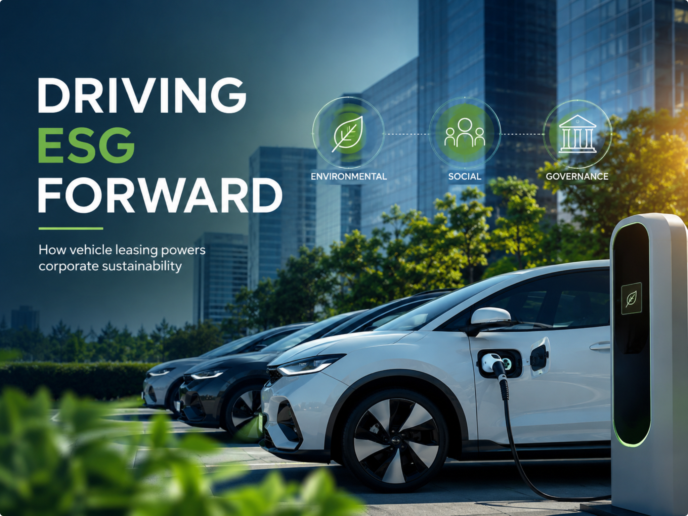
Corporate ESG (Environmental, Social, and Governance) has moved beyond reporting frameworks and into operational decision-making. One of the least discussed—but increasingly influential—areas of ESG implementation is corporate mobility, particularly vehicle leasing.
Fleet decisions used to be a simple cost equation: purchase price, maintenance, and resale value. Today, they also include carbon exposure, compliance risk, and reputational signalling. In this shift, vehicle leasing has become a practical lever for companies trying to decarbonise without disrupting operations.
ESG Is No Longer Theoretical—It’s Embedded In Fleet Decisions
For many organisations, transport and logistics represent a significant share of operational emissions. As regulatory pressure increases across the UK and Europe, companies are being pushed to measure, disclose, and reduce these emissions more rigorously.
This is where ESG becomes operational rather than theoretical:
- Environmental: reducing CO₂ emissions through electrification and fleet optimisation
- Social: improving driver safety, reducing fatigue, and enhancing working conditions
- Governance: ensuring transparent procurement, auditable emissions data, and responsible supplier management
Fleet strategy now sits within ESG strategy—not alongside it.
Regulatory pressure is accelerating this shift. Frameworks such as the UK’s Streamlined Energy and Carbon Reporting (SECR), the EU Corporate Sustainability Reporting Directive (CSRD), and expanding low-emission and clean air zones across major cities are increasing the cost of inaction. As a result, fleet decarbonisation is becoming a compliance requirement as much as a sustainability objective, forcing organisations to embed ESG considerations directly into procurement and mobility planning.
Beyond regulatory compliance, organisations are increasingly examining fleet emissions through the lens of broader carbon accounting. Depending on ownership structures and operational models, vehicle-related emissions may contribute across Scope 1, Scope 2, and Scope 3 reporting categories, making fleet strategy increasingly relevant to broader corporate carbon accounting. As ESG reporting requirements mature, businesses are facing greater pressure to demonstrate how mobility decisions contribute to measurable emissions reductions rather than simply reporting fleet activity.
Why Vehicle Leasing Accelerates ESG Goals
Vehicle leasing has quietly become one of the most effective tools for corporate sustainability transitions. Unlike outright vehicle ownership, leasing provides flexibility, scalability, and built-in infrastructure support.
Key advantages include:
1. Faster Transition To Electric Vehicles (EVs)
Leasing reduces the capital barrier to switching from internal combustion engines to EVs. Companies can roll out EVs in phases, without large upfront investment or long asset lock-in periods.
2. Continuous Technology Refresh
EV technology, particularly battery efficiency and charging infrastructure, is evolving rapidly. Leasing allows organisations to upgrade fleets more frequently, avoiding stranded assets.
Leasing also helps organisations manage residual value risk. This is particularly important in the EV market, where rapid advances in battery technology, charging capabilities, and vehicle efficiency can create uncertainty around future resale values. By avoiding long-term ownership commitments, businesses can reduce exposure to technological obsolescence while maintaining fleet flexibility.
3. Integrated ESG Reporting
Modern leasing arrangements increasingly include telematics and emissions tracking. This enables more accurate monitoring of vehicle energy use and fleet emissions, strengthening both regulatory reporting and internal ESG performance management.
4. Operational Simplicity
Maintenance, insurance, and compliance are often bundled into leasing contracts, reducing administrative overhead while improving governance transparency.
5. Total Cost of Ownership (TCO) Predictability
EV leasing can offer lower and more stable total cost of ownership compared to an internal combustion engine vehicles, particularly when factoring in fuel price volatility, reduced maintenance requirements, and available tax incentives. This allows organisations to align ESG objectives with financial planning rather than treating them as competing priorities.
6. Leasing as a Data Infrastructure Layer
Modern leasing models are increasingly integrated with telematics, energy usage tracking, and route optimisation systems. This turns vehicles into continuous ESG data sources, enabling organisations to move from annual emissions reporting to real-time monitoring and performance management.
The Rise Of ESG-Linked Leasing Products
As ESG demand has grown, leasing providers have adapted. Many now offer structured sustainability-focused products, such as:
- EV-first or low-emission fleet packages
- Carbon reporting dashboards integrated with fleet management systems
- Incentives linked to emissions reduction targets
- Lifecycle emissions assessments for each vehicle category
This signals a broader shift: leasing is no longer just a financial product—it is becoming a sustainability service.
In this model, leasing providers increasingly play a strategic role in helping organisations implement and measure fleet decarbonisation initiatives.
However, successful fleet electrification extends beyond vehicle procurement. Organisations must also address charging infrastructure, energy management, and operational readiness. Considerations such as depot charging capacity, employee home-charging arrangements, route planning, and local grid constraints can significantly influence the effectiveness of an EV transition.
Leasing providers are also expanding their services to include charging solutions and fleet energy management support alongside vehicle provision. This reflects a broader market shift in which mobility providers are moving beyond vehicle financing and towards end-to-end fleet decarbonisation services.
The Governance Challenge: Real Impact vs Greenwashing
Despite the momentum, ESG-linked mobility strategies are not without challenges. The most significant risk is superficial compliance without meaningful emissions reduction.
Common issues include:
- Overreliance on “tailpipe emissions” reporting, while ignoring upstream manufacturing emissions
- Inconsistent ESG metrics across leasing providers make comparisons difficult
- Greenwashing risk, where “EV-ready fleets” are promoted without actual adoption at scale
- Data opacity, particularly around lifecycle emissions and energy sourcing
- Limited standardisation in sustainability reporting methodologies can further complicate supplier comparison, benchmarking, and independent verification of ESG performance.
For ESG to be credible in fleet management, governance frameworks must move beyond marketing language toward standardised, auditable reporting.
A key fault line is emerging between “reported ESG compliance” and “verified operational decarbonisation.” In some cases, organisations may report improvements in emissions intensity while absolute fleet emissions remain flat or even increase due to business growth or inefficient fleet utilisation. This creates a structural gap between ESG reporting narratives and real-world emissions outcomes.
Social ESG: The Overlooked Dimension of Fleets
While environmental goals dominate the conversation, the social aspect of ESG is increasingly relevant in vehicle leasing:
- Improved driver safety through telematics and monitoring
- Reduced fatigue through route optimisation and smarter scheduling
- Better working conditions via modern, reliable vehicles
- Accessibility improvements in corporate transport policies
These factors often deliver immediate operational benefits while supporting long-term ESG commitments.
Choosing Vehicles That Support ESG Objectives
While vehicle leasing can accelerate fleet decarbonisation, vehicle selection remains a critical component of any ESG strategy. Organisations should evaluate vehicles not only on purchase or leasing costs, but also on factors such as emissions performance, energy efficiency, safety technology, lifecycle sustainability, and operational suitability.
In practice, organisations can structure vehicle selection around four core ESG-aligned criteria:
1. Duty Cycle Suitability
Assess whether a vehicle’s daily mileage, payload requirements, and route patterns are compatible with electric range and charging availability.
2. Charging and Infrastructure Readiness
Consider depot charging capacity, access to workplace or home charging, and the availability of rapid charging along operational routes.
3. Total Lifecycle Impact
Evaluate not just tailpipe emissions, but also manufacturing emissions, battery sourcing, and end-of-life recycling or reuse pathways.
4. Total Cost of Ownership and Operational Efficiency
Factor in energy costs, maintenance savings, downtime reduction, and potential exposure to emissions-related regulation or urban access restrictions.
A common mistake in ESG-driven fleet transitions is focusing solely on replacing internal combustion vehicles with electric alternatives without reassessing operational requirements. Without changes to routing, utilisation, and charging strategy, organisations may fail to achieve the expected emissions reductions or cost efficiencies. An effective ESG fleet strategy requires alignment between vehicle choice, infrastructure, and operational design.
In many organisations, a mixed fleet of battery electric, hybrid, and specialist vehicles will remain necessary during the transition phase.
Circular economy principles are also beginning to influence fleet strategy. Leasing models can support vehicle refurbishment, battery second-life applications, remanufacturing programmes, and more efficient asset utilisation across multiple ownership cycles. As regulators and investors place greater emphasis on lifecycle sustainability, organisations are increasingly evaluating environmental impact across the full lifespan of fleet assets rather than focusing solely on operational emissions.
The Future: Leasing As Mobility Infrastructure
The role of leasing is expanding beyond vehicle financing into broader mobility management. As cities introduce stricter emissions zones and companies commit to net-zero targets, leasing is evolving into a platform for:
- Electrified fleet orchestration
- Shared mobility models replacing underutilised vehicles
- AI-driven fleet optimisation
- Integration with charging networks and energy management systems
This evolution positions leasing as a coordination layer between corporate fleets, energy systems, and digital infrastructure.
 Call our expert team on