Are you a van owner, or perhaps considering leasing one soon? If so, then understanding the complexity of van drivetrains is crucial to ensure optimal performance and a smooth driving experience.
In our comprehensive blog, we dive deep into the world of van drivetrains, exploring the various types and their functionalities. Whether you’re a novice seeking basic knowledge or a seasoned van enthusiast looking to expand your expertise, this guide will equip you with the essential information you need.
What is a Drivetrain?
The drivetrain of your van is more than just a single component. It is the whole system that includes interconnected parts working in harmony with the engine to set the wheels and other components in motion. Typically, the drivetrain includes components like the transmission, differential, driveshaft, axles, CV joints, and wheels.
What Do FWD, RWD, AWD and 4WD Mean in a Vehicle, and How Do They Differ?
There are significant differences that exist beyond which wheels receive power. All four drivetrains have advantages and disadvantages that affect how the vehicle behaves on the road, especially in harsh weather. Before diving into which layout best suits a given situation and different driving types, let’s talk about the basics.
| Drivetrain | Powered wheels | Best for | Main drawbacks |
|---|---|---|---|
| FWD | Front wheels | Everyday driving, light vans, fuel economy | Less ideal for heavy towing or very high power |
| RWD | Rear wheels | Heavy loads, towing, large vans | Reduced traction on slippery roads when unloaded |
| AWD | All four wheels automatically | Mixed weather, road driving, occasional light off-road | Higher cost, weight and fuel consumption |
| 4WD (4×4) | Usually rear wheels until selected (or automatically engaged on some systems) | Serious off-road use, rough terrain | Less efficient and more complex |
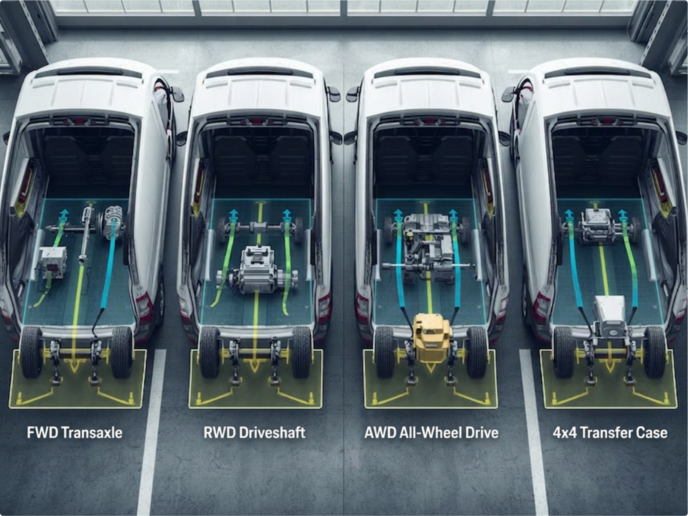
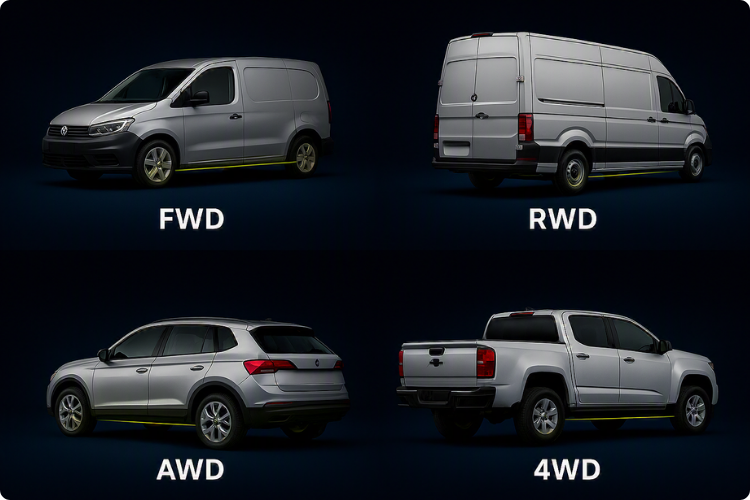
FWD prioritises efficiency, RWD delivers strength and load capability, AWD enhances all-weather grip, and 4WD is designed for off-road control.
Front-Wheel Drive (FWD) Van
In a front-wheel-drive vehicle, the drivetrain transfers the engine’s power to the front wheels only. FWD means the engine is connected to the front wheels, negating mechanical components to send power to the rear.
FWD is ubiquitous in daily-driven vehicles because of its stability and efficiency. It has less weight and, therefore, has better fuel economy. The position of the engine is either sideways or longitudinally, which puts weight on the front wheels. Because of this, there is better traction while driving. The connection between the transmission and the differential is one unit called the transaxle. The universal joints connect the wheels to the axle, allowing smooth power transmission while the wheels turn. However, this causes more wear on the front tires and suspension, as these wheels are responsible for steering.
There is no driveshaft going from the front to back because all the powertrain is one unit in the engine compartment. The bonus is the increased internal space as there is no rear differential taking up the room.
Advantages of a FWD Van:
- more room in the rear seats for occupants.
- cheaper to make as fewer components involved.
- there is more grip in slippery conditions due to the weight of the engine being over the front wheels.
- low weight because all the parts are in front and because of the removal of one additional differential and driveshaft.
- better fuel economy.
Disadvantages of a FWD Van:
- in general, less fun to drive as they instead “pull” than “push”.
- FWD vehicles are generally cheaper to manufacture due to their simpler drivetrain layout. However, drivetrain configuration has no direct impact on overall vehicle build quality.
- nose-heavy, as the engine and all the mechanical parts relying on the power are kept in the same location.
- FWD vehicles generally tend to understeer when pushed hard through corners. This means the vehicle is more likely to run wide rather than the rear stepping out, making it a predictable and stable layout for most drivers.
- in low-traction conditions, the front wheel will lose traction, making steering ineffective.
Small vans are usually FWD, and the best example is the Citroen Berlingo. Medium vans also usually come with FWD like the Peugeot Expert or Citroen Dispatch. If you’re looking for a large front-wheel-drive van, then your best option could be the Peugeot Boxer.
Rear-Wheel Drive (RWD) Van
It is the oldest drivetrain used in commercial vehicles, and, as the name suggests, these vehicles rely on their rear wheels for motion.
Rear-wheel drive remains the preferred choice for many larger commercial vehicles because it is well suited to carrying heavy payloads and towing. However, most modern passenger cars use front-wheel drive due to its lower cost, improved packaging and better fuel efficiency.
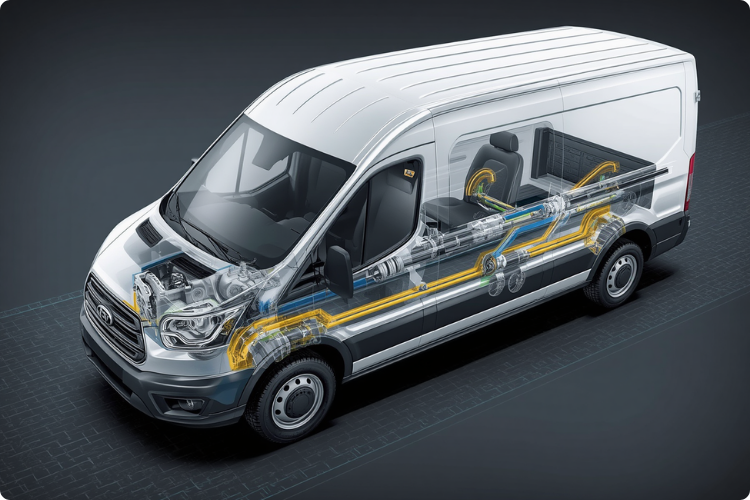
The rear-wheel-drive system uses a long driveshaft that transmits power from the engine in the vehicle’s front to the differential at the rear axle. The driveshaft connects to the transmission and differential via universal joints, which help the driveshaft rotate efficiently. The rotation of the driveshaft turns the differential, and then the differential rotates the wheels. RWD allows you to “steer with the throttle” and control how much the vehicle rotates using the gas pedal. In addition, this also lets you power out of corners better than in an FWD vehicle and carry more speed through longer turns. You have to be very careful, as it’s easy to spin the vehicle out. Lack of experience makes spinning out especially difficult to recover from if you’re not used to driving a rear-wheel-drive van.
RWD vehicles would suit those who look for the most sporty driving experience and a little extra fun.
Advantages of a RWD Van:
- rear wheels will have more grip on a dry surface, which means better handling in dry conditions.
- more balanced due to better weight distribution.
- can handle more power.
- usually better-made vehicles.
- better and more fun driving experience.
- better suited to carrying heavy payloads as vehicle weight is transferred onto the driven rear wheels when loaded.
Disadvantages of a RWD Van:
- more expensive
- less compact
- easy to oversteer
- increased vehicle weight because the components are heavier
- inexperienced drivers can find it more challenging to drive
- traction in slippery conditions is not great
Currently, the only medium van offering a choice of rear-wheel drive is the Mercedes Vito. Larger vans are usually RWD, like the Ford Transit, Vauxhall Movano and Renault Master.
All-Wheel Drive (AWD) Van
All-wheel drive (AWD) is a drivetrain that can deliver power to all four wheels. Depending on the manufacturer, this may be achieved using differentials, electronically controlled clutches or other torque-distribution systems.
AWD systems improve traction and stability by distributing power between all four wheels. Depending on the design, they may operate permanently or automatically send power to the axle with the most grip. This makes them particularly effective in wet, snowy, or low-traction conditions.
Depending on the system, AWD can provide strong traction when accelerating. It is beneficial in sloppy road conditions and when driving off-road. It can help you get through mud, sand, and other loose surfaces. Most AWD systems deliver power primarily to one set of wheels, front or rear. When detecting a slippage at one axle, energy is diverted to the other axle to find more traction.
AWD systems are helpful in rapidly changing conditions or when driving on an icy road. A common use for AWD is car-based SUVs, as well as certain cars and vans.
Advantages of an AWD Van:
- better acceleration
- increased grip and control under all road conditions
- sportier handling and traction
- works in all situations
- higher resale value
Disadvantages of an AWD Van:
- higher price
- complexity – more parts to potentially service
- reduced fuel economy
- increased weight and complexity of vehicles
- not as good in extreme off-road conditions
All-wheel drive is not a very common drivetrain for commercial vehicles. However, Ford offers some AWD models within its Ford Transit, Ford One Stop and Ford Transit L3/L4 ranges.
4-Wheel Drive (4WD or 4×4) Van
Traditional part-time 4WD systems lock the front and rear axles together so both rotate at the same speed. This provides excellent traction in low-grip conditions but makes them unsuitable for use on dry, high-grip roads due to drivetrain wind-up.
This locked power distribution is ideal for harsh, low-traction surfaces but is not suitable for use on paved roads. Driving a 4×4 on solid ground can make simple actions like turning around in a tight street very difficult because the wheels are no longer in sync. Imagine yourself doing a U-turn. In a 4WD vehicle, the inside wheel has to turn more slowly than the outside wheel, covering more ground. You might hear a rubbing noise or feel the vehicle hopping when you approach full lock, which is why most 4WD systems are part-time systems that the driver can disable. Allowing the vehicle to operate in two-wheel drive in everyday conditions improves on-road drivability. However, it still provides four-wheel traction when needed.
Advantages of a 4WD Van:
- the best traction in off-road conditions
- more power
- it can be switched to two-wheel drive to improve fuel economy
- proven, rugged technology
- the additional weight contributes to a better grip on the road
Disadvantages of a 4×4 van:
- complexity
- part-time systems should not be used on dry, high-grip roads
- higher purchase cost
- higher maintenance cost
- added weight increases the braking distance
4WD or 4×4 is a standard drivetrain for pickup trucks, like the Ford Ranger or Toyota Hilux. You can also find it in popular small vans, such as the Vauxhall Combo Cargo. Some large commercial vehicles like the Renault Master also have 4×4 van models available.
The Difference Between AWD And 4WD Vans
Although both systems can drive all four wheels, they are designed for different purposes. AWD systems prioritise everyday road safety, stability and all-weather traction by automatically varying how power is distributed between the wheels. Traditional 4WD systems are designed for maximum off-road capability and often include low-range gearing and differential locks for challenging terrain. In simple terms, AWD is ideal for road driving with occasional rough conditions, while 4WD is the better choice for regular off-road use, towing in difficult terrain and demanding work environments.
All-wheel drive is a much more recent innovation, and it’s a little more complicated but considerably more user-friendly. In comparison, a 4WD system tries to achieve maximum traction by sending as much power to the four wheels as equally as possible. AWD is all about varying the amount of power sent to each wheel, either mechanically or electronically.
At this point, you might wonder why there’s a need for both systems since both aim to distribute power to all four wheels. The difference between the two layouts is relatively tiny. Still, it significantly affects what you can tow and how far off the beaten path you can go. All-wheel drive is more of a road-going vehicle, while four-wheel drive is more for regular off-road use.
AWD isn’t quite as robust as 4WD, and it can’t match the power delivery necessary for low-speed off-roading like rock crawling. AWD does have some clear advantages over 4WD, though. These days, computers are involved in most AWD systems. Sensors on each wheel monitor traction, wheel speed, and several other data points hundreds of times per second. An engine control unit (ECU) analyses traction conditions and decides which wheel receives power. This type of system, usually called torque vectoring, has resulted in massive handling and all-weather capability improvements. Torque vectoring is a technology that automatically varies the amount of engine power sent to individual wheels. This improves grip, cornering stability and handling, particularly in wet or slippery conditions.
Ultimately, the system you choose largely depends on your driving needs and where you live. Four-wheel drive is your best choice if you plan on using your vehicle off-road and in rough terrain regularly. You can usually find it on SUVs and pickup trucks that boast the durability to match the ruggedness of a four-wheel-drive system. AWD is typically associated with road-focused vehicles and is the more practical choice for most drivers.
 Call our expert team on