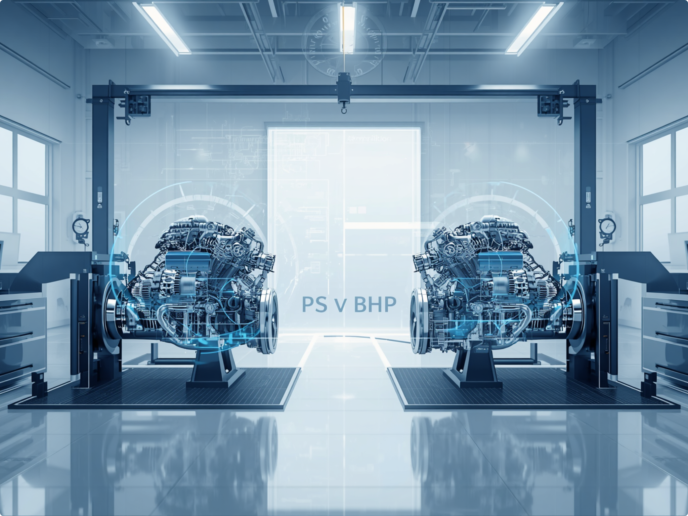
If you’re comparing car specifications, you’ve probably come across both PS and BHP. While they both measure an engine’s power output, they aren’t exactly the same unit.
The main difference is simple:
- PS is metric horsepower, commonly used across Europe and Japan.
- BHP is brake horsepower, an imperial unit traditionally used in the UK and other Commonwealth countries.
- 1 BHP = 1.0139 PS, meaning PS figures are around 1.4% higher for the same engine.
For example, a car producing 300 BHP would also be rated at approximately 304 PS.
For everyday drivers, there’s virtually no real-world difference—it’s simply a different way of expressing the same engine power.
| Feature | PS | BHP |
|---|---|---|
| Full name | Pferdestärke | Brake Horsepower |
| Measurement system | Metric | Imperial |
| Commonly used in | Europe, Japan | UK, Commonwealth countries |
| Engine power measured at | Crankshaft | Crankshaft |
| Unit size | Slightly smaller | Slightly larger |
What Does PS Mean?
PS stands for Pferdestärke, which translates from German as “horse strength.”
It is the metric version of horsepower and has been widely adopted throughout mainland Europe and many Asian markets. Manufacturers including BMW, Mercedes-Benz, Volkswagen, Audi and Toyota often quote power figures in PS.
One PS equals 735.5 watts.
What Does BHP Mean?
BHP stands for Brake Horsepower.
The word “brake” refers to the dynamometer used to measure engine power—not the vehicle’s braking system.
Like PS, BHP measures the engine’s power at the crankshaft before drivetrain losses occur. It remains the preferred measurement in the UK automotive industry and is also commonly seen in Australia and other Commonwealth countries.
One BHP equals 745.7 watts.
PS to BHP Conversion
Since the units are only slightly different, converting between them is easy.
BHP = PS × 0.9863
PS = BHP × 1.0139
| BHP | PS |
|---|---|
| 100 | 101.4 |
| 150 | 152.1 |
| 200 | 202.8 |
| 250 | 253.5 |
| 300 | 304.2 |
| 400 | 405.6 |
| 500 | 506.9 |
Why Do Different Manufacturers Use PS or BHP?
The unit usually depends on where the vehicle is sold rather than the vehicle itself.
European manufacturers generally publish power figures in PS, while UK publications often convert these figures into BHP for local audiences. American manufacturers usually use HP (Horsepower) instead.
Because of this, it’s common to see the same car advertised with different power figures depending on the country.
Does PS or BHP Matter?
Not really.
A vehicle rated at 250 BHP performs virtually identically to one listed as 253 PS because they’re describing the same engine output using different units.
The important thing is comparing like-for-like measurements. If one car is listed in PS and another in BHP, simply convert one figure before comparing.
 Call our expert team on