
The UK new car market recorded its best June performance in six years, with registrations climbing 11.4% year-on-year to 213,166 vehicles as electric models continued to drive growth across both fleet and private sectors.
| Category | Registrations | Market Share |
|---|---|---|
| Total Market | 213,166 | 100% |
| Fleet & Business | 132,595 | 62.2% |
| Private Buyers | 80,571 | 37.8% |
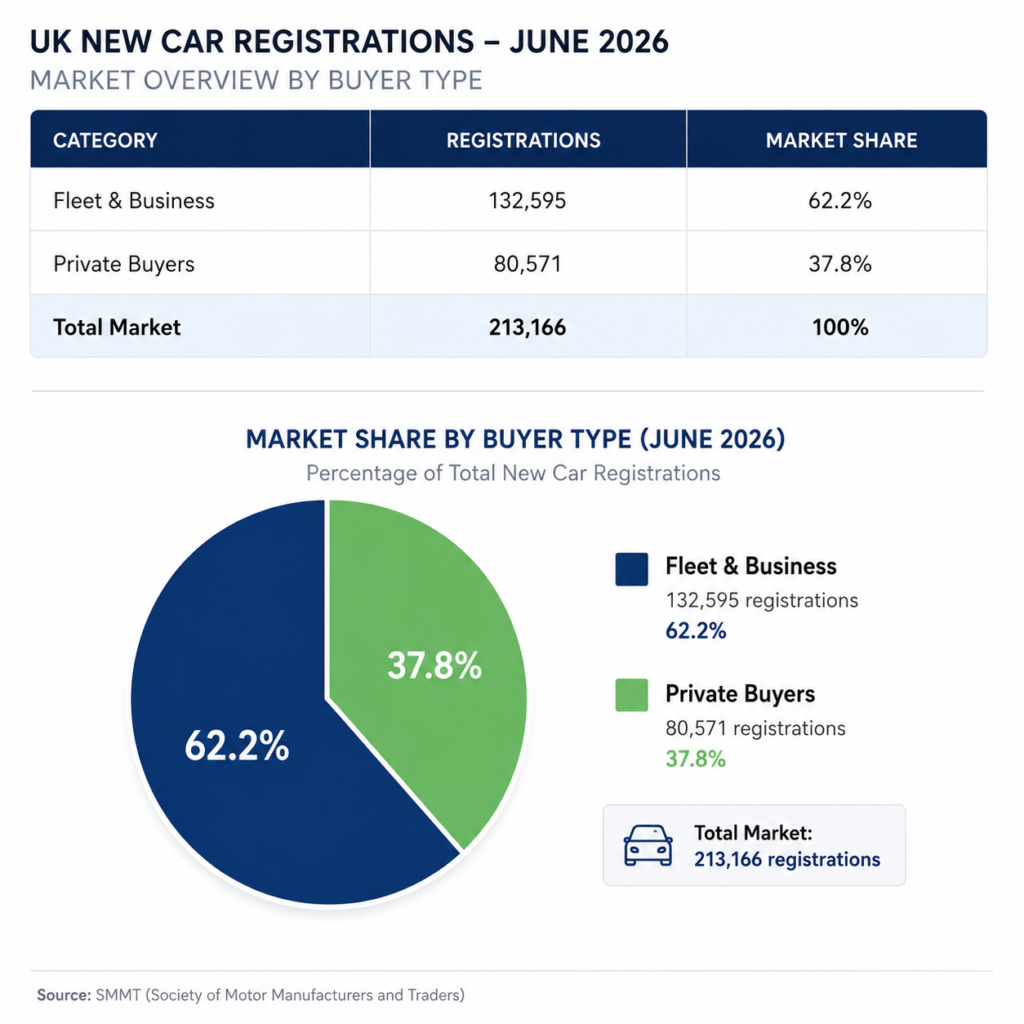
Fleet and business buyers remained the largest contributor to new registrations, taking delivery of 132,595 vehicles during the month. That represents a 10.7% increase compared with June last year and gives fleets a commanding 62.2% share of the overall market.
Private buyers also returned to showrooms in greater numbers, with registrations increasing by 12.5% to 80,571 units. The rise suggests consumer confidence is gradually improving as more electric and hybrid models become available across a wider range of price points.
The latest figures continue a positive trend seen throughout the first half of the year. Fleet and business registrations have now reached 685,099 vehicles year-to-date, representing a 7% increase over the same period in 2025.
Battery Electric Vehicles Continue To Lead Growth
| Powertrain | Registrations | Market Share |
|---|---|---|
| Battery Electric (BEV) | 63,950 | 30.0% |
| Hybrid (HEV) | 29,874 | 14.0% |
| Plug-in Hybrid (PHEV) | 26,702 | 12.5% |
| Petrol | 84,541 | 39.7% |
| Diesel | 8,099 | 3.8% |
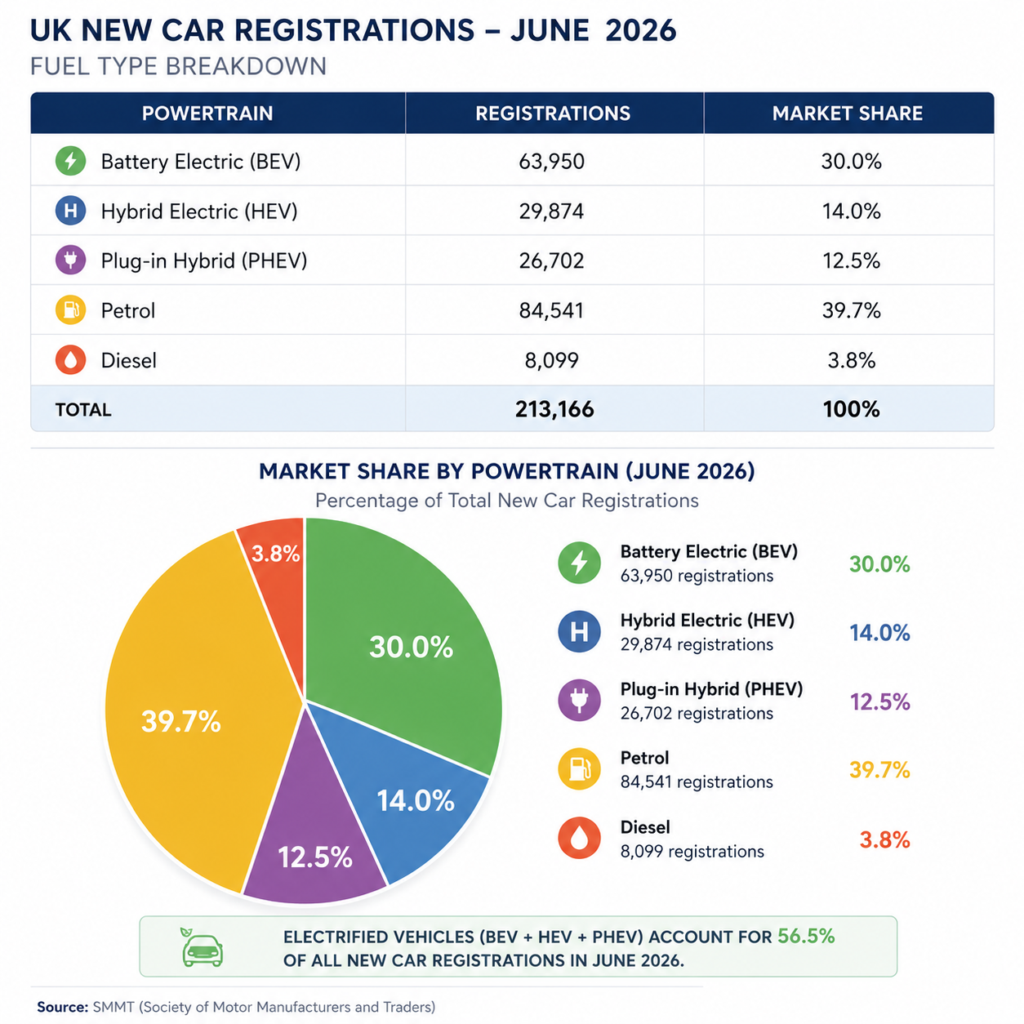
Electrified vehicles were once again the main driver behind the market’s expansion.
Battery electric vehicles (BEVs) secured a 30% share of all new registrations in June, their highest monthly market share so far this year. Hybrid electric vehicles (HEVs) accounted for 14% of registrations, while plug-in hybrid models (PHEVs) represented a further 12.5%.
Combined, more than half of all new cars registered during June featured some form of electrified powertrain, underlining the continued shift away from conventional petrol and diesel vehicles.
Despite the record performance, fully electric vehicles currently account for around one in four new registrations across the year to date. While that represents significant progress, the market remains below the level required to meet the UK’s Zero Emission Vehicle (ZEV) mandate.
Industry Warns Further Progress Is Needed
Although electric vehicle uptake continues to improve, manufacturers believe additional measures will be required if future government targets are to be achieved.
Current registration levels indicate that electric vehicles would need to account for more than 40% of all new car registrations during the remainder of the year to meet the existing ZEV requirements.
Industry leaders argue that demand alone is not increasing quickly enough, despite manufacturers investing billions of pounds in developing new electric models, expanding production and introducing increasingly competitive offers for consumers.
Many within the sector are calling for greater policy certainty, continued investment in charging infrastructure and reforms that make the transition to electric vehicles more achievable for both manufacturers and motorists.
Lower Ownership Costs Helping Attract Buyers
Affordability is becoming an increasingly important factor in encouraging EV adoption.
A growing selection of lower-priced electric models is entering the market, while improvements in battery technology and stronger competition between manufacturers are helping to reduce purchase costs.
Running costs also continue to strengthen the case for switching. Stable home charging prices have provided motorists with greater certainty compared with fluctuating petrol and diesel prices, while the expanding used EV market is making electric vehicles accessible to a wider audience.
As increasing numbers of ex-fleet electric vehicles enter the second-hand market, buyers who may not have considered purchasing a new EV are now finding more affordable alternatives.
Outlook Remains Positive
The strong performance during the first six months of the year provides further evidence that the UK’s automotive market is continuing its recovery.
Fleet operators remain at the forefront of the transition towards electrification, while improving private demand suggests the market is becoming more balanced as consumer confidence grows.
Looking ahead, industry experts believe continued investment, clear long-term government policy and further improvements to charging infrastructure will be key to sustaining momentum throughout the remainder of 2026.
If current trends continue, the UK new car market is expected to comfortably exceed two million registrations this year, with electric vehicles playing an increasingly important role in driving future growth.
Find Your Next Vehicle Today
Inspired by the latest developments in the automotive market? Whether you’re ready to make the switch to electric, upgrade your current vehicle or simply explore what’s available, we’ve got you covered.
Browse our latest selection of cars, SUVs, vans, electric vehicles, hybrids and commercial vehicles from leading manufacturers. With a wide choice of models and competitive prices, finding your next vehicle has never been easier.
Start exploring today and discover the perfect vehicle for your lifestyle or business.
 Call our expert team on